
Monday, January 27, 2020 is designated the International Day of Commemoration in memory of the victims of the Holocaust. In honour of their memory, and for so many more reasons, this article was written and published after my 2007 visit to Dachau.
Dachau: From Darkness to Light
by Joyce E. Rempel
Dachau – the significance of this name will never be erased from German history.
It stands for all concentration camps which the Nazis established in their territory.
~Dr. Eugen Kogon [1]
I rise early. It is the sixth day of our European tour. Sleep is impossible as I consider today’s destination: Dachau—the first Nazi death camp.
Haunting words invade my thoughts from a friend who first toured Dachau at age 18: “It left such a deep impression on my heart,” she reflects, “I struggled with sadness and despair for weeks afterward, when I realized how abhorrently evil human beings can be. I will never forget it.”
The Dachau Concentration Camp Memorial Site draws over 700,000 visitors annually. It is the only camp to have existed throughout the entire twelve years of Nazi rule, 1933-1945. The Memorial Site opened as a place of political education in 1965 and opened an expanded documentary exhibition in 2003. The Memorial provides information about the history of the former concentration camp and addresses the horrors of the Nazi regime. It also serves as a cemetery for over 30,000 murdered prisoners.
Everyone is somber as we board the bus to Dachau. Our tour guide is German, married to an American, lives in France, holds a degree in Art History, speaks three languages; she is confident, humorous and articulate. Each day, she gives interpretive talks about upcoming destinations and their place in European history.
“You need to understand,” she begins grimly, “It is difficult for me to speak of this. All German school children are reminded about this black spot on our history. Every year we learn how Hitler took the best German qualities—efficiency, precision, pride—and exploited them for his own dark advantage; how he took nationalism to the extreme and made ethnocentrism an integral part of Nazi ideology. As we grow up hearing year after year of the atrocities our own people committed, shame about this part of our history overshadows any good that may have been present. Since WWII, we have abandoned any sense of patriotism or pride of country. Imagine growing up with this burden, this blemished heritage,” she urges, “and think about the natural biases and antagonism that surface.”
“Be honest,” she continues, “When you hear the word ‘German’ what is the first thing that enters your mind? Is it not the Holocaust?”
All of us are silent. Yes, Germany and the Holocaust are inexorably linked. Even my own German roots are a source of some indefinable discomfort. I am taken aback at the realization of my own prejudice as I reflect on the more recent whispers of those who fear a unified Germany. As if reading my thoughts, our guide pulls me back to reality.
“Make no mistake,” she concludes, “It was not just ‘a bad German gene’ that allowed Hitler to rise. Genocide can occur anywhere aggression is tolerated, an ethnic group is singled out or governing powers are allowed to rule unchecked.” (Note: this was in 2007)
* * * * * *
Huge, broad and barren, the gravelled hue of the camp blends with washtub gray clouds above. Overcast and sullen, the sky seems to cry with us at our visit, as if to wash away the spectre of death we are about to encounter.
Former prisoner, Edgar Kupfer-Koberwitz, describes the feeling in his memoir: “Something pitiless loomed over everything, something awful, something icy that was frightening.” [2]

My first stop is at the Visitor Centre to view a 20-minute documentary. The screening room is hot and crowded, standing room only. The film outlines conditions in the camps and a rule of terror by SS officers: forced labour, insufficient nutrition, medical experimentation, inhumane crowding, humiliation, intimidation, beatings, tree and pole hangings, torture and execution. The visual images and emotional impact are devastating. I feel completely overwhelmed and need to get outside but a large crowd of school children sweeps me along toward the Exhibition Hall. Heart pounding, I struggle against the flow and finally stumble out into the brooding light.

I wonder, along with death camp survivor Terrence Des Pres, “How much self-esteem can one maintain, how readily can one respond to the needs of another, if both stink, if both are caked with mud and feces?” [5]
Stepping into the first barrack, I imagine myself living in such conditions. The corridor is crowded with visitors and the pace is uncomfortably slow. An uncommon sense of claustrophobia begins to rise, so I escape through an early exit and head toward the far end of the compound. At this barren and crushing place, I crave the comfort of wide-open space.

Columns of tall trees line the centre pathway of the prisoners’ block. At least the prisoners had this small consolation of nature. Leaves to whisper in the dark night. Rough bark against which to lean in the few moments of daylight they treasured outside the barracks. Remnants of creation, testimony to life which will not be silenced.
Sharp rocks under foot ensure no grass grows on the pathway. Continuing to the far end of the camp, the site of the original crematorium now gives rise to three memorial chapels. Each one serves as an individual remembrance for Jews, Catholics and Protestants. Yet even here, the horror and anguish of the camp is integrated into each design.

At the Jewish Memorial Site, the structure slopes downward.
The entrance ramp is bounded on both sides by a sculpted barbed wire railing.
Inside burns Ner Tamid, the eternal light.

Central to the structure, a towering menorah rises through an opening in the roof,
stretching into the light like an arm reaching up for freedom.
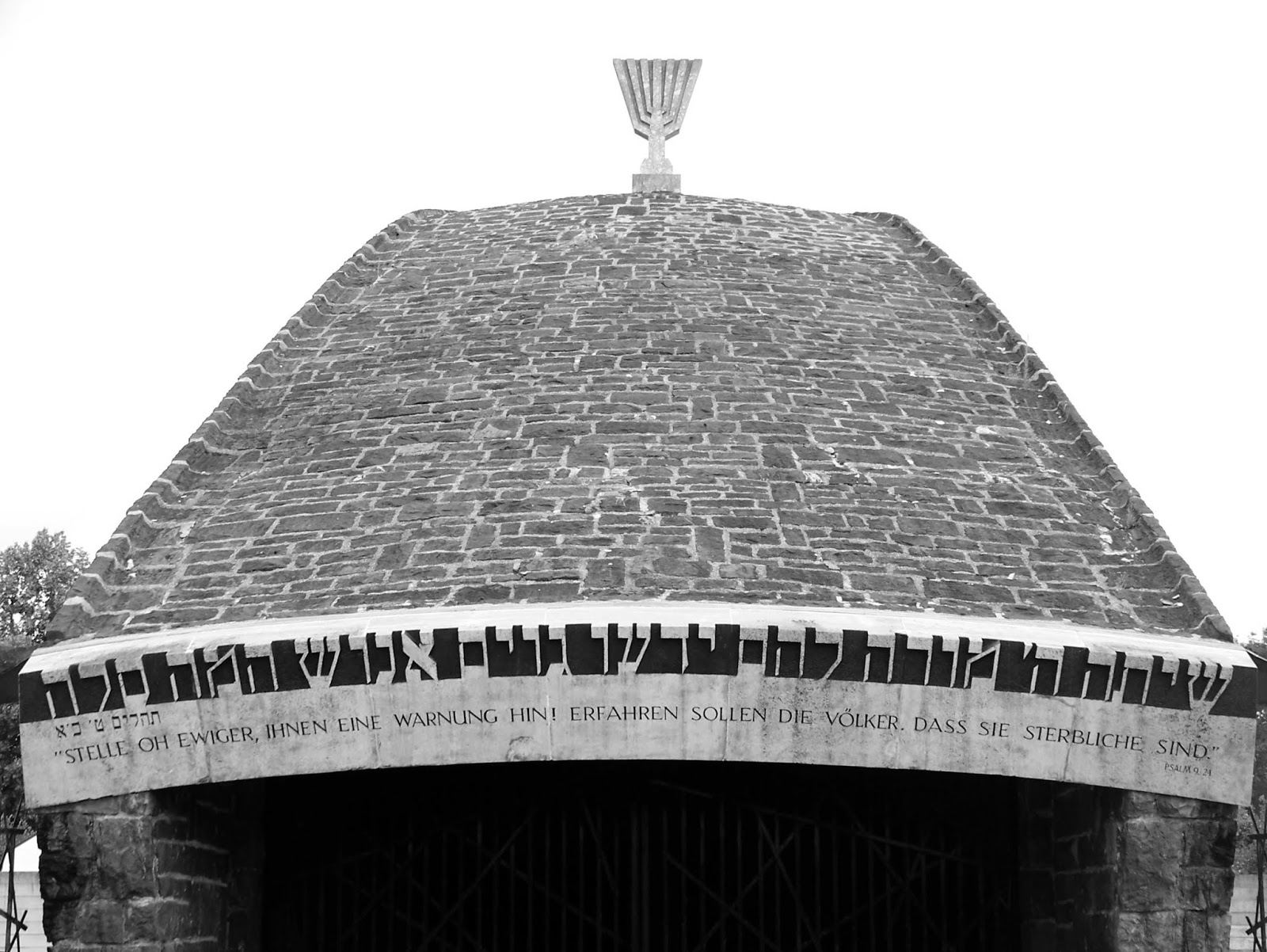
Above the entrance, an engraved Psalm:
“Put them in fear, O Lord: that the nations may know themselves to be but men.”

The central position of the Catholic Mortal Agony of Christ Chapel and its open circular form symbolizes liberation from captivity by Christ. Suspended over the entrance is a crown of thorns.

On the back of the Christ Chapel, a plaque declares: “Here in Dachau every third victim was a Pole. One of every two Polish priests was martyred. Their holy memory is venerated by their fellow prisoners of the Polish clergy.”
I shudder, feeling besieged by the sheer numbers and move on to the Protestant Church of Reconciliation.

There are no right angles in the chapel, an intentional design in direct opposition to the dictated order and uniformity of the former camp. Steps lead down to a narrow, dark entrance that opens into a light interior courtyard. At the point where darkness and light meet, a steel gate is inscribed: “Hide me under the shadow of Thy wings.” [6]

 Inside the church, the sculpture of a metal cross depicts a crushed person still rising up within. Another shows an angel supporting the dying.
Yes, represented here alongside the anguish is a small measure of comfort: divine support for those in whom no strength remains.
Leaving the memorials, I enter the respite of heavier green foliage and mature trees outside the original compound walls, a retreat formerly enjoyed only by the SS. On the way, I pass another small octagonal memorial, the Russian-Orthodox "Resurrection of our Lord" Chapel. Its main icon shows the resurrected Christ leading the camp inmates out of their barracks and through the gate held open by angels.
By now, it is nearly mid-day and the time for our departure is near, yet my steps slow on the path toward the gas chamber and crematoria. As much as I want to flee to the safety of our tour bus, I continue. I am walking in the steps of the prisoners; should I turn back now when I face the most difficult station?
I take deliberate deep breaths and step inside. The gas chambers are sterile and clean, resembling shower rooms. It is small consolation to learn that mass executions did not occur in the Dachau gas chambers because liberation came to the camp before they were in full service. Moving ahead, I can barely bring myself to look directly at the brick ovens. Many others stop; take photographs or gawk like voyeuristic tourists at a highway crash site.
Why do we memorialize a place such as Dachau? I wonder how one would display photos of death rooms. What is the attraction of preserving images that burden our sensibilities? Are there horrific places in the wider world, such as the death camps, that we should attempt to eliminate from our emotional memory? Why remember?
Historian Wolfgang Benz writes: “Remembering is an element of self-reflection, an element of identity, and, like forgetting, necessary for all human existence. Remembering forges self-confidence and peace, but remembering also torments and is painful. Nowhere does memory crystallize with more power and oppressive force than at those historical sites and places where the events shaping this very remembrance and determining memory occurred: the authentic sites of history.” [7]
In a documentary film, The United States Holocaust Memorial Museum reveals they recently acquired a scrapbook containing selected personal photographs of Auschwitz SS officers relaxing off duty while hundreds of prisoners were being murdered only a short distance away. [8]
In the film, Becky Erbelding, Archivist of the Holocaust Museum, asserts, “We need the reminder that Nazis weren’t red-eyed, pointy-tooth monsters. They were people like you and I, whose society had gotten to a point that (murder) was morally acceptable behavior. That’s a very scary concept.”
Judy Cohen, Director of Photographic Collection, concurs: “When you see people who look like nice guys in a benign setting and we know for a fact they were doing monstrous things, then it raises all sorts of questions about man’s capacity for evil. In a different setting, would they still be monsters?”
Ms. Erbelding continues, “Because of all the overwhelming evidence of what we know was going on in (the camps), it makes it even more chilling that they are having so much fun doing it. It makes you think how people could come to this. They don’t look like monsters, they look like me. They look like my next-door neighbor. Is he capable of that? Am I?”
As I view the gas chambers and the crematoria, I am gripped at a deeper level, unable to de-personalize this vision of death. I imagine those perpetrating the crime. I can visualize my family, my best friend, myself—entering those showers and consumed by those flames. But could I visualize my family, my best friend, myself—as the ones who flip the switch? The possibility terrifies. The exit cannot come soon enough.
Behind the building, I seek solace on the quiet path wrapping around the burial sites of prisoners’ ashes. The Star of David marks the Jewish site. At the Christian site, a cross rises and I pause to reflect. The atrocities are unimaginable, yet the facts are clear: human beings committed these acts.

Do I understand how humans can be so abhorrently evil? Not at all. I am not certain I want to understand, but in condemning these vile actions, I dare not raise the self-righteous scales of comparative goodness and dismiss my own capacity for sin. Jesus himself explained to Nicodemus, an elite teacher of the Jewish law, that humans by nature choose darkness rather than accept God’s light. [9]
As I move toward the main camp gate on this gray day in July, just like my friend years earlier, I am profoundly shaken and anxious to escape. A few snap-happy tourists are trying to capture a photo of the gate before they enter. One holds the gate shut as I approach. They will have to retake their picture. Nothing will bar my exit to freedom.
The purpose of the Dachau memorial is to unite the living in their defense of peace and freedom and in reverence of human dignity. [10] The exhibition exists “to contribute to keeping humankind from repeating a similar disaster.” [11] It preserves and documents horrific atrocities of man. It also shows the hope and faith that enabled prisoners to survive the camps, to endure despite unspeakable acts. The exhibition declares the truth. It shines a light to dispel the darkness.
Dachau opens my eyes to the capacity of humanity for both evil and good. I see the documented facts and much of it is frightening; but I also see hope, endurance and redemption. Like the icon in the orthodox chapel, I am led through the gate into light, truth and freedom. My response? To remember; to unite with others to preserve peace, freedom and respect for human dignity. No prejudice. No silence. No genocide.
Never again.


